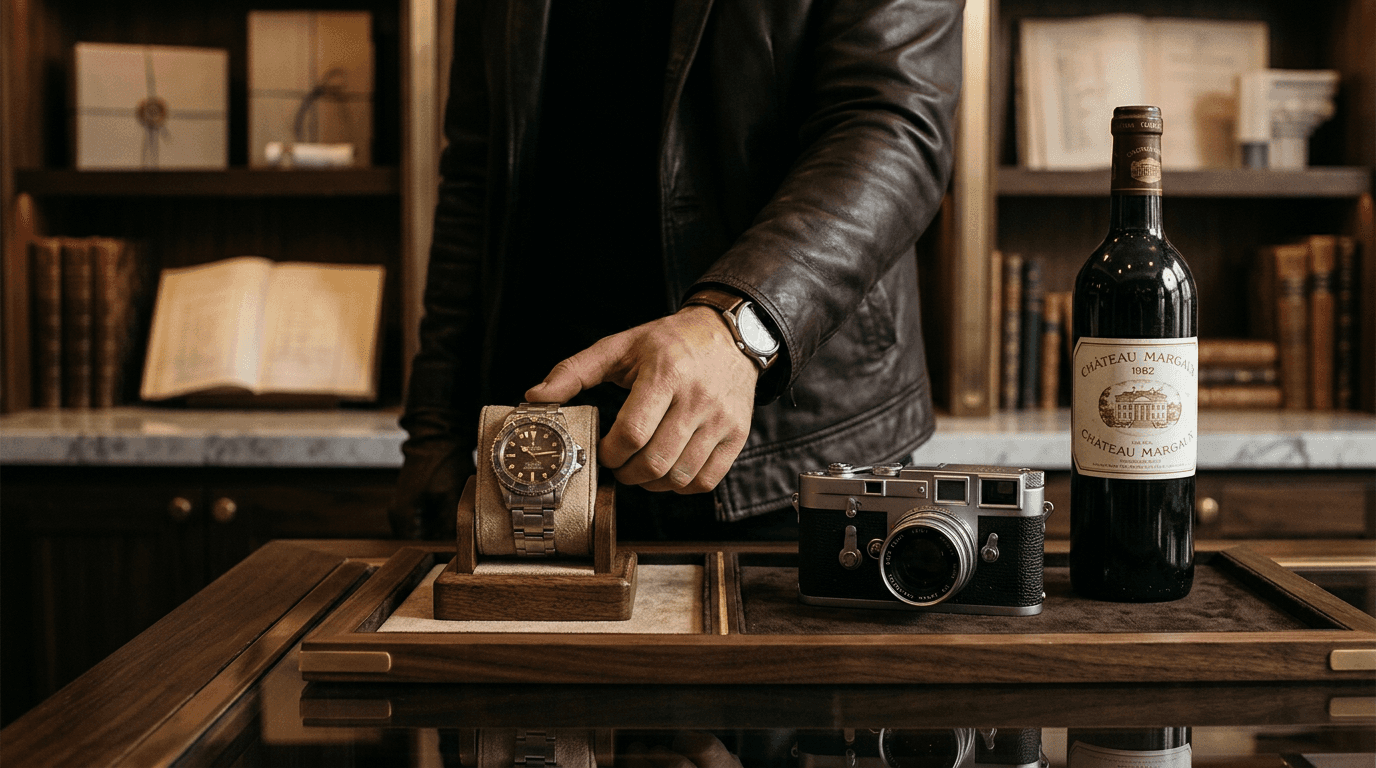

He had the right brand. He even had the right model. What he didn't realize until it was too late was that his specific production year featured a "Tritium" dial that had aged into a creamy, pumpkin-orange patina. To the untrained eye, it was old paint. To the market, it was a lightning strike of value.
In the world of high-end collecting, we often talk about brands and models. But the real "alpha" for serious collectors—and the biggest trap for the uninitiated—is the Production Year. Whether it’s a vintage Porsche, a "pre-LVMH" handbag, or a specific vintage of Bordeaux, certain years act as a demarcation line between "nice to have" and "holy grail."
The "Golden Era" Effect
Markets are often driven by nostalgia, but they are anchored by manufacturing reality. Take, for instance, the "Transitional" years. In the watch world, the mid-to-late 1980s are a goldmine because brands were moving from old-school acrylic crystals to modern sapphire. A watch from 1986 might look like a vintage piece but run with the reliability of a modern one. Collectors hunt these "best of both worlds" years because they represent a specific moment of evolution.
We see this in the classic car market constantly. A 1973 Porsche 911 is often prized over a 1974. Why? Because 1974 brought new federal bumper regulations that changed the silhouette of the car forever. That one-year gap represents the end of the "long hood" era. To a Budding Collector, they both look like vintage Porsches. To the Market, that one-year difference can represent a six-figure price delta.
When "Flaws" Become Features
Sometimes, a specific year matters because the manufacturer actually got something "wrong."
Consider "Tropical" dials or "Crazed" lacquer on instruments and handbags. During specific production windows—often due to a change in paint suppliers or a shift in UV-protective coatings—certain batches reacted to sunlight in ways the factory never intended. Products from these years don’t just age; they evolve.
In the world of rare coins or trading cards, a "Year 1" production run (like a 1999 Base Set Pokémon Zard or a 1986 Fleer Basketball pack) carries a weight that later years can never replicate. It’s the "Genesis " effect. You aren't just buying an asset; you’re buying the origin story of the hobby itself.
The Shift to "Small Batch" Thinking
For the serious collector, the obsession with production years is about scarcity you can prove. As luxury brands have scaled to meet global demand, older production years—years where "handmade" meant a guy with a loupe, not a robotic arm—have become the ultimate status symbol.
This is why we’re seeing a massive surge in "Neo-Vintage" interest (roughly 1990–2005). These years represent the final era before the massive industrialization of luxury. If you have a bag from the year a specific creative director started, or a car from the last year a manual transmission was offered, you hold a piece of history that is mathematically impossible to replicate.
Why This Matters to You
If you’re a budding collector, understanding production years prevents you from overpaying for a "near-miss." It helps you realize that two items that look identical on a screen can have vastly different market profiles.
If you’re a serious collector, these nuances are where your equity lives. But here is the catch: most standard insurance companies don’t understand the difference between a 1988 "Pre-C" handbag and a 2024 model off the shelf. They see a "black leather bag."
That’s where we come in. At WAX Collect, we built our platform to recognize these subtleties. Our free collection management tools allow you to catalog the specific serial numbers and production years that make your pieces unique. And if you’re ever unsure why your 1998 instrument is suddenly trending, our concierge specialists—people who live and breathe this culture—are there to help you navigate the data.
Protecting a collection isn't just about the price tag; it’s about knowing why your 1994 piece is different from a 1995. Because in this market, one year can make all the difference in the world.