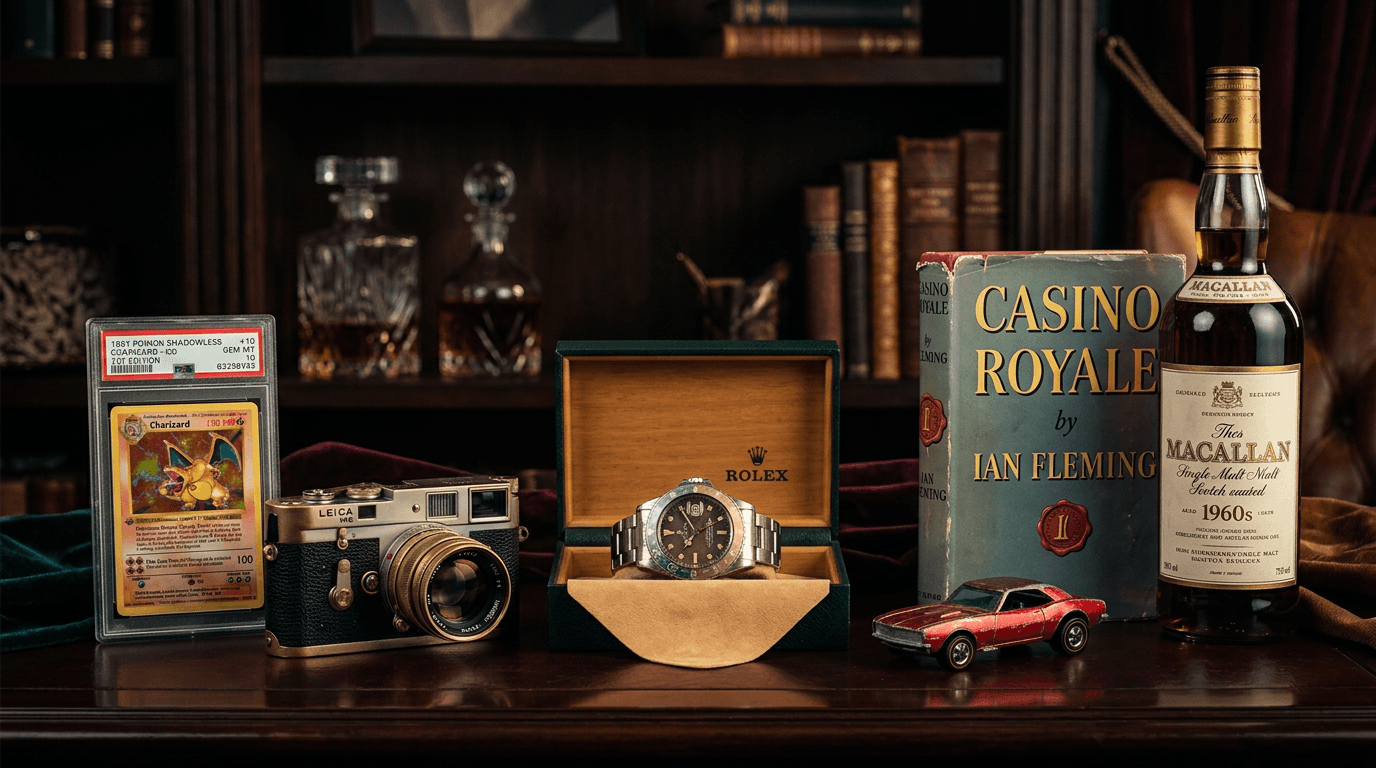

Typography has become the ultimate "tell." Whether it’s the serif on a Rolex "Long E" GMT-Master or the kerning on a 1952 Topps baseball card, the obsessives have realized that the way a word is printed is often more important than the word itself. We are entering an era where font is fortune.
The Psychology of the Typeface
Why does a specific "S" or a slightly hooked "7" command a five-figure premium? To the uninitiated, it looks like pedantry. To the enthusiast, it represents a moment in time.
Before the era of digital precision, printing was a tactile, imperfect human endeavor. Dials were pad-printed; cards were run through lithographs; guitar headstocks were hand-decaled. These subtle variations in lettering—the "flat-top" fours or the "open" sixes—serve as an unhackable DNA. They tell us exactly which factory produced the piece, which year it was born, and most importantly, whether it is authentic.
In a market flooded with high-quality "super-clones" and polished-to-death vintage relics, typography is the one thing that is incredibly difficult to fake perfectly. It requires an understanding of mid-century ink bleed and the specific pressure of a 1940s printing press. When a collector studies typography, they aren't just looking for beauty; they are looking for truth.
Across the Disciplines: The Serif as a Status Symbol
While horology has led the charge—think of the "floating" text on early Cosmograph dials or the "serif" vs. "sans-serif" debates among Submariner aficionados—this obsession has bled into every corner of the luxury asset world.
In the world of vintage guitars, the specific thickness of the "Fender" spaghetti logo can differentiate a $50,000 investment from a $5,000 modified part-caster. In sports cards, the shift from one typeface to another on a player’s nameplate can signify a "corrected" error card, turning a common print into a rare high-value tier. Even in luxury handbags, the heat-stamp font on a Birkin is a primary tool for authentication, where the shape of the "O" in "Paris" acts as a fingerprint for the artisan who touched it.
This level of granularity is what separates the "buyer" from the "collector." The buyer sees a watch; the collector sees a "serif-dial mark I." One owns an object, the other owns a piece of history.
Why It Matters Now
We live in an age of frictionless digital consumption. Everything we see on our screens is rendered in clean, scalable vectors. Perhaps that is why we are so drawn to the "analog" imperfections of vintage lettering. There is a soul in the ink-heavy "E" of an old comic book cover that a digital font simply cannot replicate.
For the serious collector, studying typography is also a defensive play. As prices for blue-chip collectibles remain high, the risk of "franken-pieces"—items made of mixed parts—grows. If you know that a certain font wasn't introduced until 1974, but the case back says 1970, your knowledge of typography just saved you from a six-figure mistake.
Safeguarding the Nuance
At WAX Collect, we understand that your collection isn't just a list of items; it’s a library of these tiny, crucial details. This is exactly why we built our platform to be more than just an insurance tool.
When you use our collection management system, you aren't just cataloging a "Watch" or a "Card." You’re documenting the specific hallmarks, the serial ranges, and those typographic quirks that define its market value. Whether you’re utilizing our white-glove concierge service to authenticate a new acquisition or simply organizing your vault, we believe that the smallest details deserve the strongest protection.
Because in this market, the difference between "good" and "legendary" is often found in the tail of a comma.