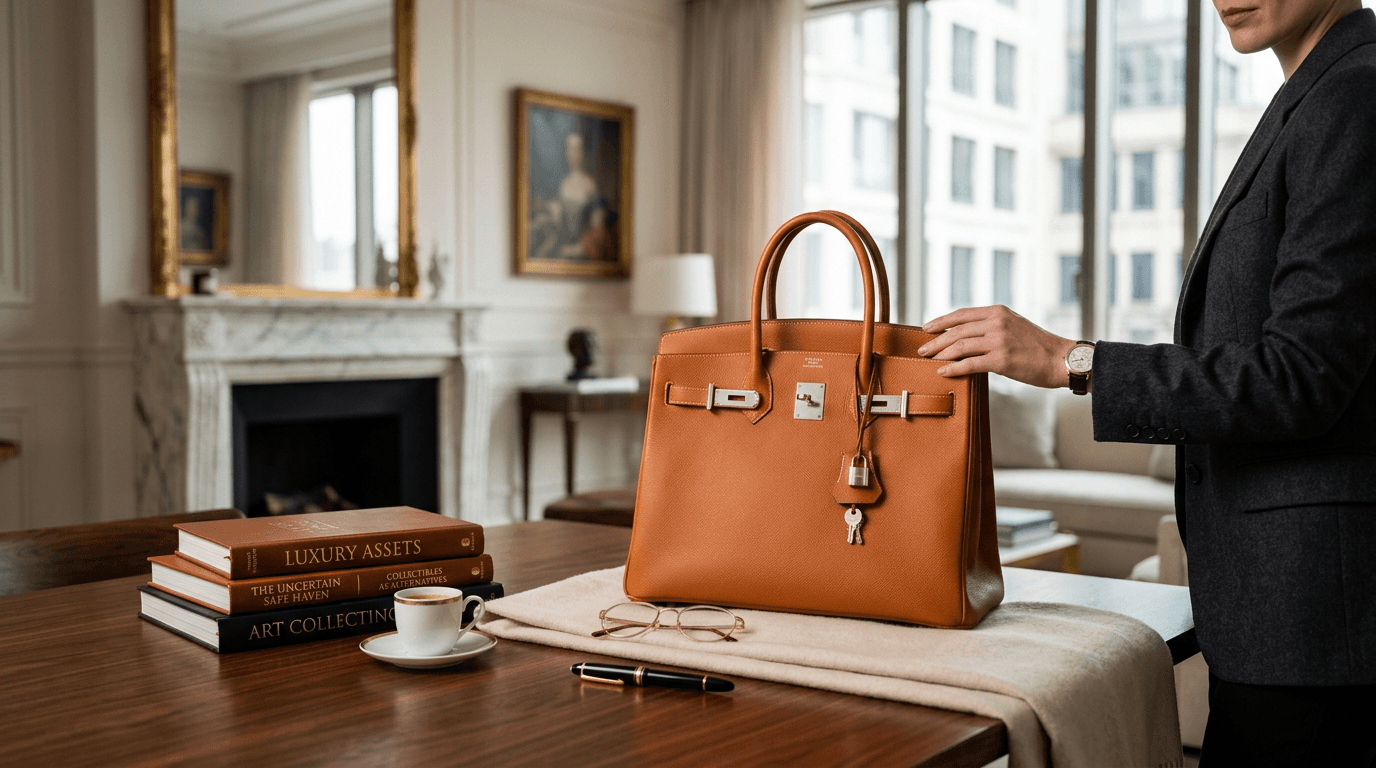

It’s a seductive narrative. We want to believe that our vices are actually virtues—that the five-figure sum we dropped on a Rose Azalée Epsom Kelly wasn’t a splurge, but a shrewd move into a non-correlated asset class. And to be fair, the data occasionally backs the delusion. The Knight Frank Luxury Investment Index has famously shown handbags and watches outperforming the S&P 500 over certain ten-year stretches.
But here is the cold, hard truth that most "investment grade" influencers won’t tell you: A market that trades on passion is inherently more volatile than one that trades on P/E ratios. When you treat a luxury object purely as an asset, you stop being a collector and start being a speculator. And right now, the speculators are getting a very expensive education.
The Correction is the Great Filter
For the last three years, we lived in a fantasy land. Zero-interest rates and "revenge spending" fueled a mania where every steel Nautilus and Every Game-Worn Jordan 1 hit a new ceiling. But as we move into a more "sober" market, we’re seeing a massive bifurcation.
The "hype" pieces—the stuff people bought because they saw it on a celebrity’s wrist or an influencer’s grid—are bleeding value. Meanwhile, the truly rare, provenance-heavy pieces are holding steady. Why? Because serious collectors don't panic-sell when the market flattens. They wait.
For the enthusiast, this is actually good news. The "flippers" are exiting the building. The noise is dying down. We’re returning to a market where knowledge—real, deep-dive, "I know which factory produced this dial" knowledge—is the only currency that matters.
Why You Can’t Manage What You Can’t Measure
If you’re going to treat your collection as a serious asset class, you have to stop treating your record-keeping like a hobby. You wouldn't manage a $100,000 brokerage account by keeping trade confirmations in a shoebox, yet I see collectors with half-million-dollar watch boxes who couldn't find their original warranty card if their life depended on it.
This is where the "New Era" of collecting begins. It’s not just about acquisition; it’s about stewardship.
In a volatile market, the "Value" of your collection isn't what a Chrono24 algorithm tells you it's worth today. It's the aggregate of its condition, its documentation, and its protection. This is exactly why we built the free collection management tools at WAX. We wanted to kill the spreadsheet. You need a live dashboard of your passion—a place where your high-res photos, appraisal values, and provenance records live together. Because when the market shifts—and it always does—having your digital house in order is what separates the professionals from the pretenders.
The Insurance Gap: A Luxury Tragedy
Here is a scenario I see far too often: A collector buys a Royal Oak in 2019 for $25k. They add it to their homeowner’s policy. In 2024, that watch is "worth" $50k on the secondary market. If that watch is stolen, the homeowner's policy—burdened by sub-limits and outdated appraisals—might cut a check for $5,000. Maybe $10,000 if they’re lucky.
Treating luxury as an asset means protecting it according to its real-world market value, not its MSRP. At WAX, we’re carrier-agnostic for a reason. We don't care about pushing a specific policy; we care about matching your risk profile (your city, your travel habits, your "safe vs. wear" ratio) to a solution that actually pays out when the worst happens. No deductibles, no "gotchas," just global protection for the things that make life interesting.
The Bottom Line
Whether you’re a budding collector or a seasoned whale, the goal remains the same: Own the best version of what you love. If it goes up 20% this year, fantastic. If the market dips, you should still be able to look at that piece and feel the same rush you did when you first unboxed it.
The "Safe Haven" isn't the bag itself—it’s the intelligence you bring to the hunt and the rigor you apply to its protection. Let the speculators chase the hype. We’ll be over here, cataloging the classics.