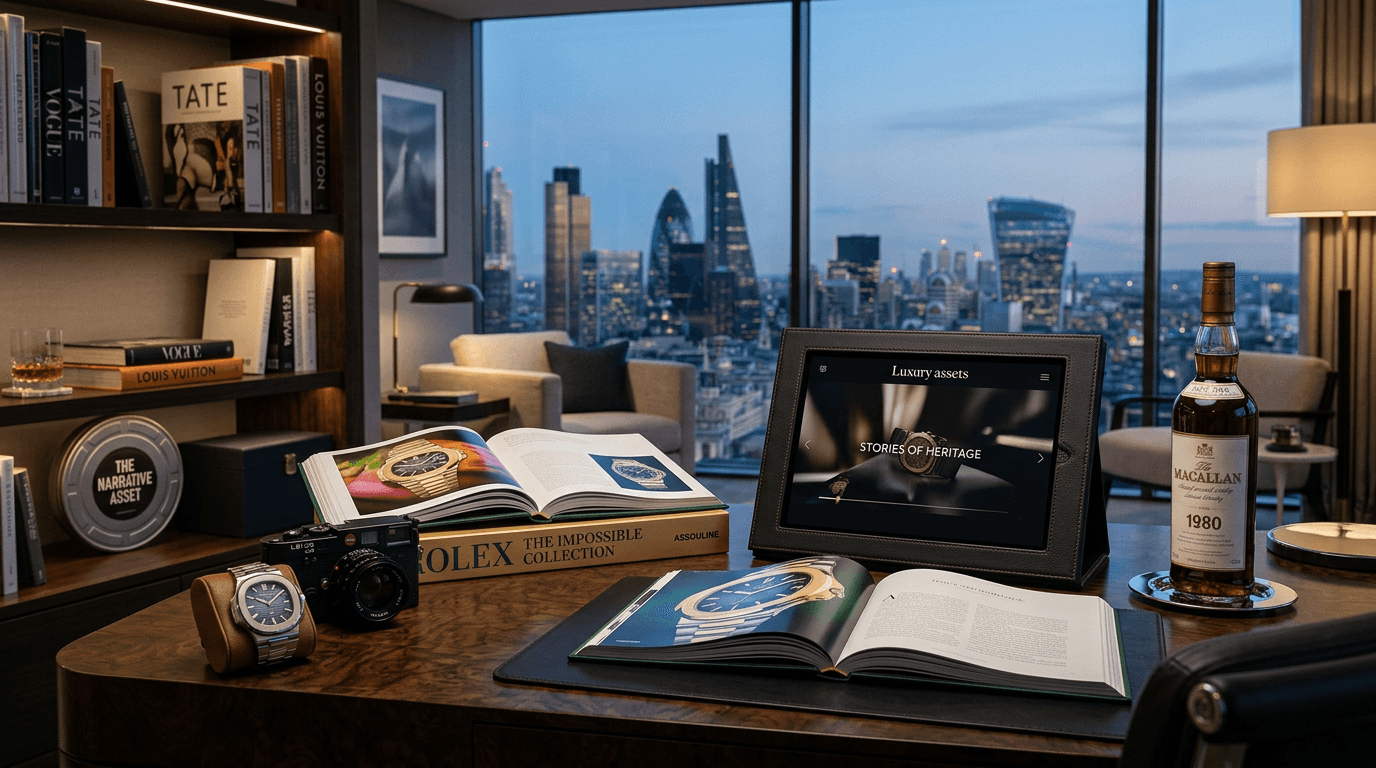

Today, that boundary has dissolved. If you look at the landscape of high-end horology, fashion, and automotive, you’ll notice a shift: the world’s most prestigious houses are no longer just manufacturers; they are media conglomerates. They are producing feature-length documentaries, commissioning high-brow literary journals, and hosting chart-topping podcasts.
But why has the "Product" taken a backseat to the "Story"? For the modern collector, the answer lies in the psychology of value.
From Goods to Gospel
We are living in an era of "peak stuff." For a serious collector, the technical specifications of a perpetual calendar or the leather grade of a Birkin are baseline expectations. They are no longer the primary differentiators. To command loyalty in a saturated market, brands must move beyond the what and dominate the why.
By becoming media companies, brands like Rolex, LVMH, and Porsche are effectively controlling the narrative of their own heritage. Take, for instance, the rise of brand-owned editorial platforms. When a brand produces its own magazine—think The Patek Philippe Magazine or Ferrari Magazine—it isn't just marketing; it’s world-building. These publications don't scream "buy this"; they whisper "belong to this."
This shift matters because it shifts the asset from a physical object to a cultural landmark. When you buy a Speedmaster, you aren't just buying gears and springs; you are buying into the cinematic legacy of space exploration that Omega has meticulously curated through decades of documentary-style storytelling.
The Influence of the "Editor-in-Chief" Designer
We see this most vibrantly in the appointment of creative directors who act more like media moguls than tailors. The late Virgil Abloh was perhaps the pioneer of this, treating Louis Vuitton not just as a trunk maker, but as a broadcasting station for art, music, and social commentary.
By producing scripted content and podcasts, brands are engaging in "soft power." They are influencing collector culture by defining what is "relevant." For the enthusiast, this means the value of their collection is often tied to the brand’s ability to stay in the cultural conversation. A brand that stops telling stories is a brand that begins to depreciate.
Data, Depth, and the Digital Ledger
In this new media-heavy landscape, the collector’s challenge has evolved. It is no longer enough to simply find the asset; one must understand its place in the shifting cultural zeitgeist. This is where the intersection of media and management becomes critical.
As brands release more content—archival deep-dives, "making-of" series, and limited-edition monographs—the provenance of an asset becomes more complex and data-rich. Collectors are now managing stories as much as they are managing objects.
This is where we at WAX Collect see the modern collector's greatest hurdle: organization. When a brand releases a documentary that highlights the rarity of a specific vintage reference, the market value can shift overnight. Keeping track of these nuances requires more than a spreadsheet; it requires a dynamic ecosystem.
Our free collection management tools allow collectors to catalog their pieces with the same level of editorial detail that the brands themselves use. Whether it’s documenting the specific media mentions of a piece or utilizing our white-glove concierge to verify the historical context of a new acquisition, the goal is the same: to ensure your physical asset matches its cultural valuation.
Why This Matters to You
Whether you are a budding collector or a seasoned veteran, you must recognize that you are no longer just a consumer—you are an audience member.
Luxury brands are betting that if they can capture your attention through a podcast or a film, they will eventually capture your portfolio. For the serious collector, this media-forward approach is a double-edged sword. It provides a richer, more immersive experience, but it also means market sentiment is more susceptible to the "hype" generated by high-production storytelling.
The savvy collector looks past the cinematography to the core value of the asset, while utilizing platforms like WAX to ensure that as these brands grow their media empires, your personal empire remains protected, insured, and meticulously organized. In a world where luxury is a narrative, make sure you own the story of your own collection.


