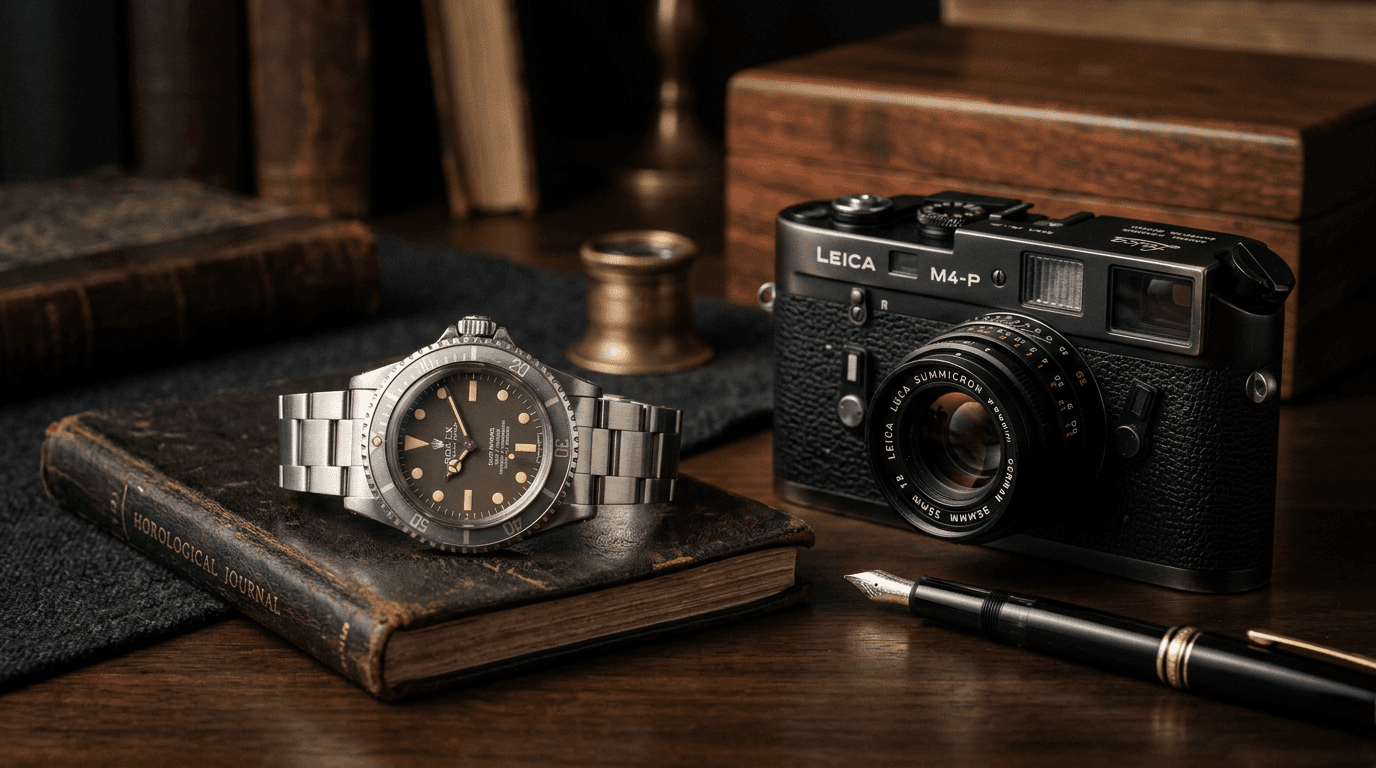

In the world of mass production, consistency is the ultimate goal. But in the rarefied air of high-end horology, fine jewelry, and heritage leather goods, the most human moments happen during the "shifts." We call these transitional references—those short-lived specimens produced when a brand was moving from one era to another.
They are the mechanical equivalent of a "glitch in the matrix," and for the serious collector, they represent the holy grail of storytelling.
The Anatomy of an In-Between
What exactly constitutes a transitional piece? It’s often a beautiful "mismatch." Imagine a vintage Rolex Submariner produced in the early 1980s—the reference 16800. It arrived with the modern sapphire crystal and a higher-beat movement, yet for a fleeting window, it retained the matte dial and painted indices of its predecessor. It is a bridge between the tool-watch grit of the 70s and the luxury sheen of the modern era.
These pieces usually emerge during four specific catalysts:
Material Evolution: Moving from tritium to luminova, or plexiglass to sapphire.
Leadership Shifts: A new Creative Director or CEO changing the logo or "signature" hardware.
Technological Upgrades: New movements being fitted into old-style cases.
Short-Lived Experiments: A specific colorway or material that was discontinued after six months due to production difficulty.
To an outsider, these details look like errors. To an enthusiast, they are the fingerprints of history.
Why the "Glitch" Matters
Nostalgia plays a heavy hand here. There is something deeply romantic about a piece that shouldn't exist by modern manufacturing standards. When you hold a "Sigma dial" watch—where the tiny Greek letters at six o’clock signify the use of solid gold indices—you aren't just holding a timepiece; you’re holding a physical record of a specific industry agreement from the 1970s.
But beyond the sentiment, there is the undeniable pull of rarity. In a market where anyone with a sufficient bank balance can walk into a boutique and buy the current catalog, the transitional reference offers "insider" status. It requires a level of "if you know, you know" (IYKYK) knowledge. It proves that you haven't just bought an asset; you’ve studied the lineage.
Take, for example, the early 2000s "Series 0" bags from a certain Parisian house, or even specific "flat four" bezels on anniversary divers. These aren't just accessories; they are anomalies. And in the luxury world, scarcity—especially unintentional scarcity—is the primary driver of value.
The Risk of the Rare
As someone who spends my days helping people protect what they love, I have seen the "Transitional Trap" firsthand. Because these pieces are defined by subtle nuances—a font thickness, a specific serial range, a slightly different alloy—they are the hardest to value and the easiest to misidentify.
Standard insurance companies often struggle with this. If you lose a "standard" modern reference, a general carrier sees the MSRP and cuts a check. But if you lose a 1980s transitional piece with a specific "spider dial" or a rare experimental clasp, a standard policy might only cover the cost of a basic modern replacement. That isn't just a financial loss; it’s a heartbreak.
This is why we built the WAX Collect platform. We know that a reference 16750 isn't just "a watch"—it’s a specific moment in time. Our tools allow you to catalog these nuances, upload high-resolution proof of the "glitch," and work with our white-glove concierge team who actually understand why a "serif" vs. "non-serif" dial changes the valuation by thousands of dollars.
Protecting the History
Collecting transitional pieces is an act of preservation. You are a steward of a manufacturing hiccup that will never happen again. As brands become more digitized and their supply chains more rigid, these "human" variations are disappearing.
Whether you are a budding collector eyeing your first neo-vintage piece or a seasoned veteran chasing a specific short-run handbag, remember that the value lies in the deviation from the norm.
At WAX, we believe that if a piece is special enough for you to hunt down, it’s special enough to be protected properly. Our platform doesn't just give you a place to list your items; it gives you a community of specialists who value the "in-betweens" as much as you do. Because at the end of the day, we aren't just insuring objects. We’re insuring the stories they tell.