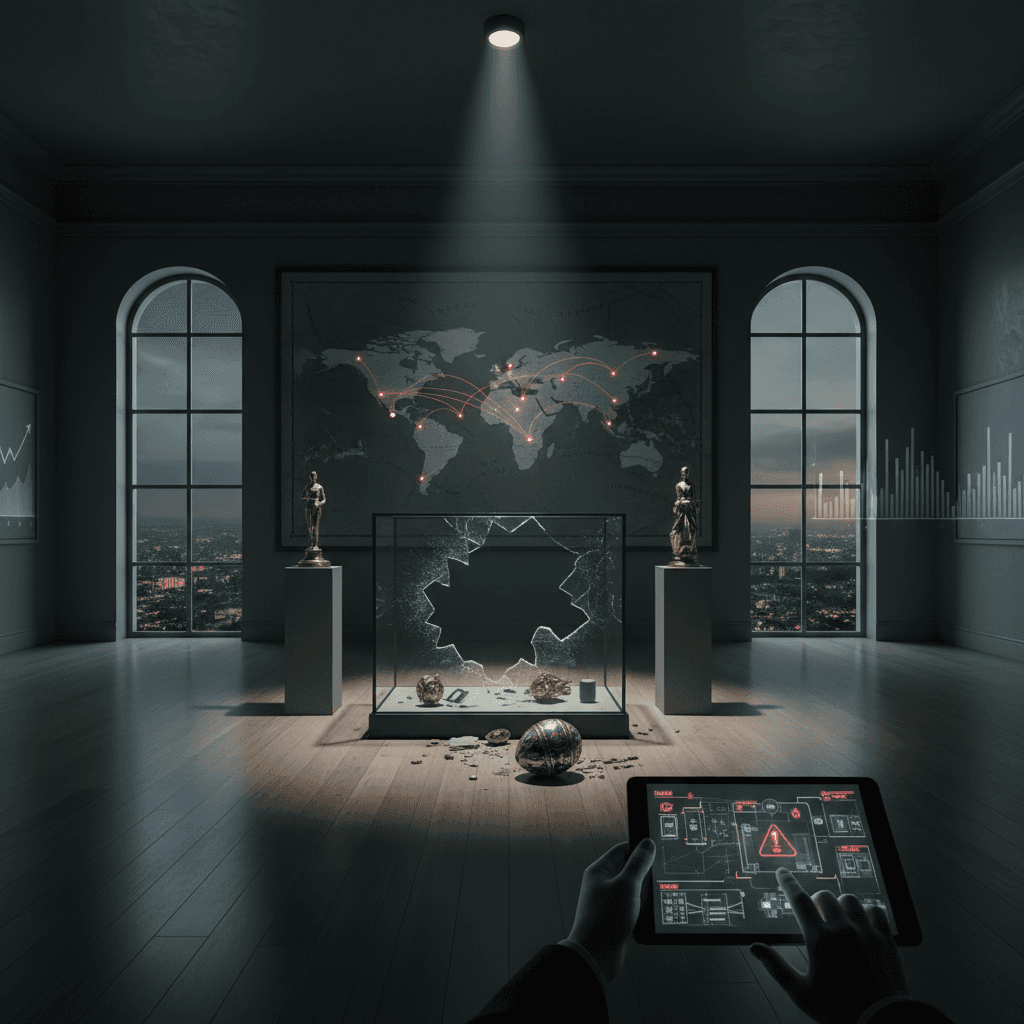

But as recent law enforcement investigations have begun to reveal, these "isolated" incidents are frequently just the visible tip of a much more predatory iceberg.
In a recent, high-profile case, what started as a response to a single residential burglary evolved into the discovery of a staggering criminal network. Authorities uncovered a sophisticated operation moving millions of dollars in stolen luxury goods—Hermès Birkins, high-flown horology, and heirloom jewelry. This wasn't a crime of opportunity; it was a logistics business.
For the modern collector, this highlights an uncomfortable shift: theft in today’s market is becoming more professional, more networked, and far more targeted than the "smash-and-grab" tropes of the past.
Not Random, But Targeted
Modern burglary has entered the era of Big Data. As enthusiasts, we live for the "wrist check" or the "state of the collection" (SOTC) post. We trade on public forums and attend enthusiast meetups. But this digital and social footprint creates a roadmap for those with ill intent.
High-value collectibles—particularly watches and handbags—are the ultimate "liquid" assets for the criminal world. They are:
Compact: A million dollars in vintage Patek Philippes can fit in a jacket pocket.
High Value: The price-to-weight ratio beats almost any other commodity.
Globally Resaleable: A bag stolen in Los Angeles can be sold in a boutique in Tokyo or via a private Telegram group in London within forty-eight hours.
When authorities find "hubs" of stolen goods, it proves that these weren't just thieves; they were specialists who knew exactly which houses held the most significant "concentration risk." They knew what was in the safe before they even crossed the threshold.
The Reality of Recovery: A Bitter Truth
There is a romanticized notion that if the police "bust the ring," you get your property back, and life returns to normal. As someone who talks to collectors and specialist insurers daily, I can tell you: the reality is rarely that poetic.
Even when items are recovered, several hurdles remain:
The Chain of Custody: Stolen items are often held as evidence for months or years, trapped in a legal limbo where you cannot touch, sell, or wear them.
The Damage: Criminal networks aren't known for their white-glove handling. We’ve seen pristine "Full Set" pieces returned with scratched lugs, missing cards, or humidity damage from being stored in sub-optimal conditions.
The Identification Crisis: If you cannot definitively prove a specific serial number belongs to you through high-resolution documentation or a digital registry, the path to reclaiming your asset becomes a bureaucratic nightmare.
The Hidden Risk: Concentration
We often talk about "diversifying" a portfolio, but we rarely talk about diversifying our physical risk. Many collectors keep their entire life’s work in a single home safe. While convenient, this creates a single point of failure.
At WAX, we often assist clients who are navigating this exact realization. We’ve seen cases where a single breach didn't just take a watch; it wiped out a legacy. This is why we advocate for more than just a heavy door and a code. Security is a mindset that involves cataloging your assets in a way that is decoupled from the physical items themselves.
Beyond Physical Security
An alarm system is a deterrent, but it isn’t a strategy. True protection in the 21st-century collector market requires a layered defense:
Digital Cataloging: Using tools like the WAX Collect management system to store high-res photos, serial numbers, and appraisals in a secure, cloud-based vault. If the watch is gone, the data shouldn't be.
Market-Valued Coverage: Most standard homeowners' policies are woefully inadequate for luxury assets. They often have low "sub-limits" and don't account for the volatile secondary market prices of "hype" pieces.
Discretionary Security: Rethink what you share online and with whom. The "circle of trust" in collecting is getting smaller for a reason.
Why This Matters
This matters because collecting is, at its core, an emotional pursuit. We buy these pieces to celebrate milestones, to connect with engineering, or to preserve a piece of fashion history. To have that taken away by a coordinated syndicate is a violation that transcends financial loss.
The scale of these recently uncovered networks is a signal that the world has noticed what we carry on our wrists and over our shoulders. As the value of the collectible market continues to soar, the sophistication of those looking to exploit it will grow in tandem.
Being a "serious collector" today means being serious about your "back office." It means moving beyond the passion of the acquisition and into the discipline of protection. Because in a world where your collection is visible, living without a strategy isn't just a risk—it's an invitation.