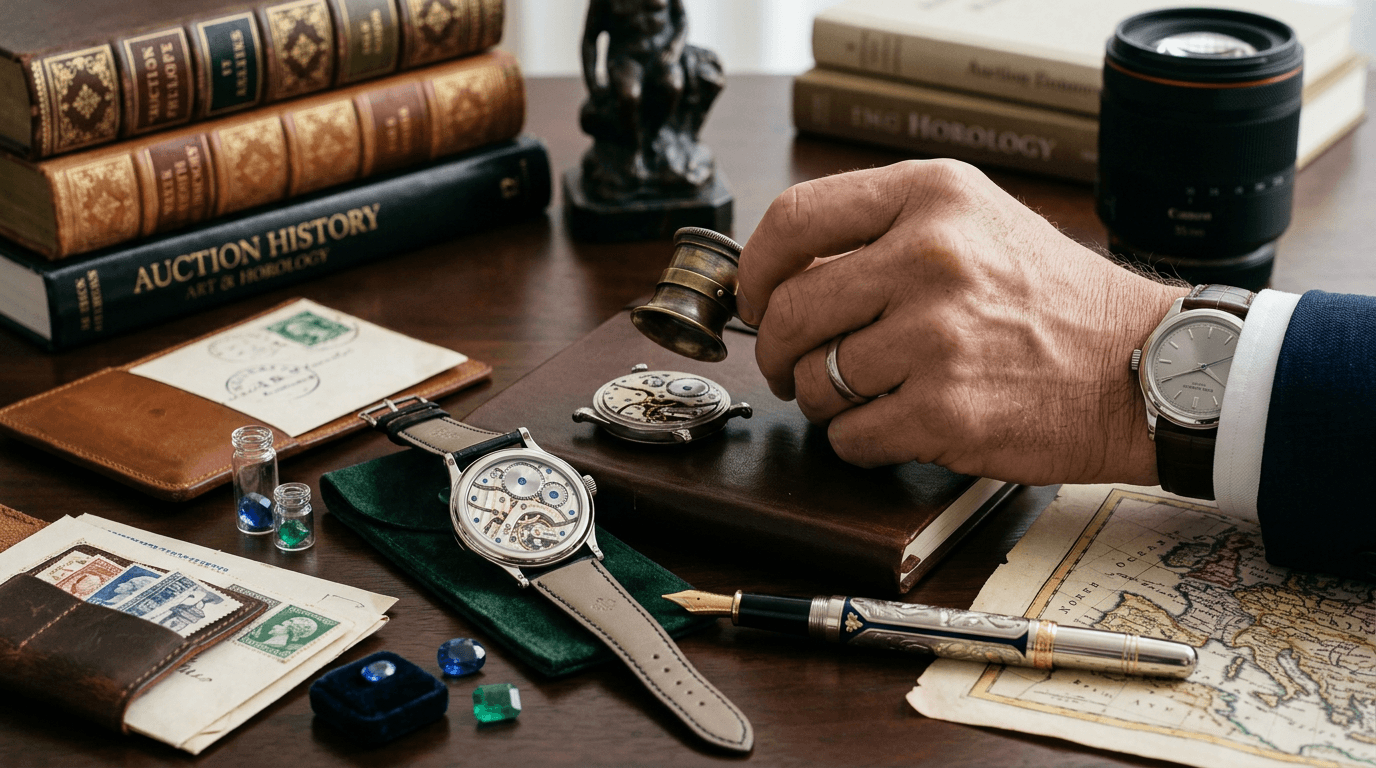

To the uninitiated, it looks like snobbery. To the market, it’s the difference between a record-breaking hammer price and a "Passed" lot.
At WAX Collect, we spend our days navigating the intersection of passion and cold, hard data. Whether it's a 1960s reference Submariner or a Birkin in Togo leather, the "greats" don’t look at the object—they look through it. They aren’t blinded by the brand name on the dial or the logo on the dust bag. They are looking for the "ghosts" in the machine.
Here is what the seasoned eye notices while everyone else is still busy taking a photo for Instagram.
The Geography of Wear
A newcomer sees a scratch on a vintage watch case and thinks "damage." A seasoned collector sees a "softened" lug and thinks "over-polished."
In the vintage watch world, the metal is the geography of the piece’s soul. If a 50-year-old watch has razor-sharp bevels and factory-correct chamfers, it’s a miracle (and worth a fortune). If the edges are rounded and smooth like a sucked-on lozenge, it means a well-intentioned watchmaker took a buffing wheel to it in 1982. To a pro, that’s a tragedy. They want the scars of time, not the plastic surgery of a restoration.
The same applies to classic cars. We aren't looking at the paint; we’re looking at the "shut lines"—those tiny gaps between the door and the fender. If they aren't perfectly uniform, the car has a story it isn't telling you, likely involving a ditch and a body shop.
The "Aura" of the Material
There is a specific, tactile "honesty" to luxury materials that can’t be faked, but takes years to recognize.
Consider the "hand" of a Hermès bag. A novice looks at the color; a collector looks at the stitching tension. They’re looking for the slight irregularities that prove a human being—not a machine—pulled that thread through the leather. They’re looking for the way the leather "puddles" when empty.
In the world of fine art and high-end trading cards, it’s about the "surface." A seasoned card collector doesn't just look for a 10 grade; they look for the "spectral flash" of the hologram or the specific porosity of the card stock. They can feel when a surface has been "processed" or cleaned. It’s a Sixth Sense developed through thousands of hours of tactile failure.
The Provenance of Silence
The most important thing a veteran notices isn't on the object at all—it’s in the paperwork. But not just any paperwork.
Newcomers want the original receipt. Veterans want the service history from a specific, obscure workshop in Switzerland or a provenance trail that includes a stop at a legendary (if defunct) gallery in Soho. They notice when a "full set" includes the original hangtags and the wax seals that most people threw away in the lobby of the boutique.
This isn't just about hoarding paper; it's about Risk Management. Those small details are the connective tissue that anchors an asset to its value.
Why This Matters
If you’re just starting out, this level of granularity can feel intimidating. It shouldn't. It should be your roadmap.
The transition from "consumer" to "collector" happens the moment you start valuing the nuances over the aesthetics. Why? Because the market rewards the nuances. In a downturn, the "pretty" pieces sit on the shelf. The "correct" pieces—the ones with the sharp lugs, the original movement spacers, and the documented ownership—are the ones that hold their ground.
At WAX Collect, we built our platform to bridge this gap. Our collection management tools allow you to catalog these micro-details—the serial numbers, the condition reports, the high-res macros of those specific "birthmarks"—so you aren't just owning an object, you’re mastering its history. And if you’re still training your eye, our concierge specialists are the ones who’ve spent decades in the trenches, ready to tell you if that "pristine" dial is actually a very clever reprint.
Collecting is an exercise in seeing what others ignore. The joy isn’t just in the possession; it’s in the hunt for the truth hidden in the details.


