In the world of high horology, we often talk about "craftsmanship" as a broad marketing term. But for Jochen, a master of guilloché based in Pforzheim, Germany, craftsmanship is an endangered species. As the luxury world leans further into automation to meet surging global demand, Jochen represents a vanishing breed: the specialist who holds the "lost" keys to the aesthetic soul of a watch.
The Architecture of Light
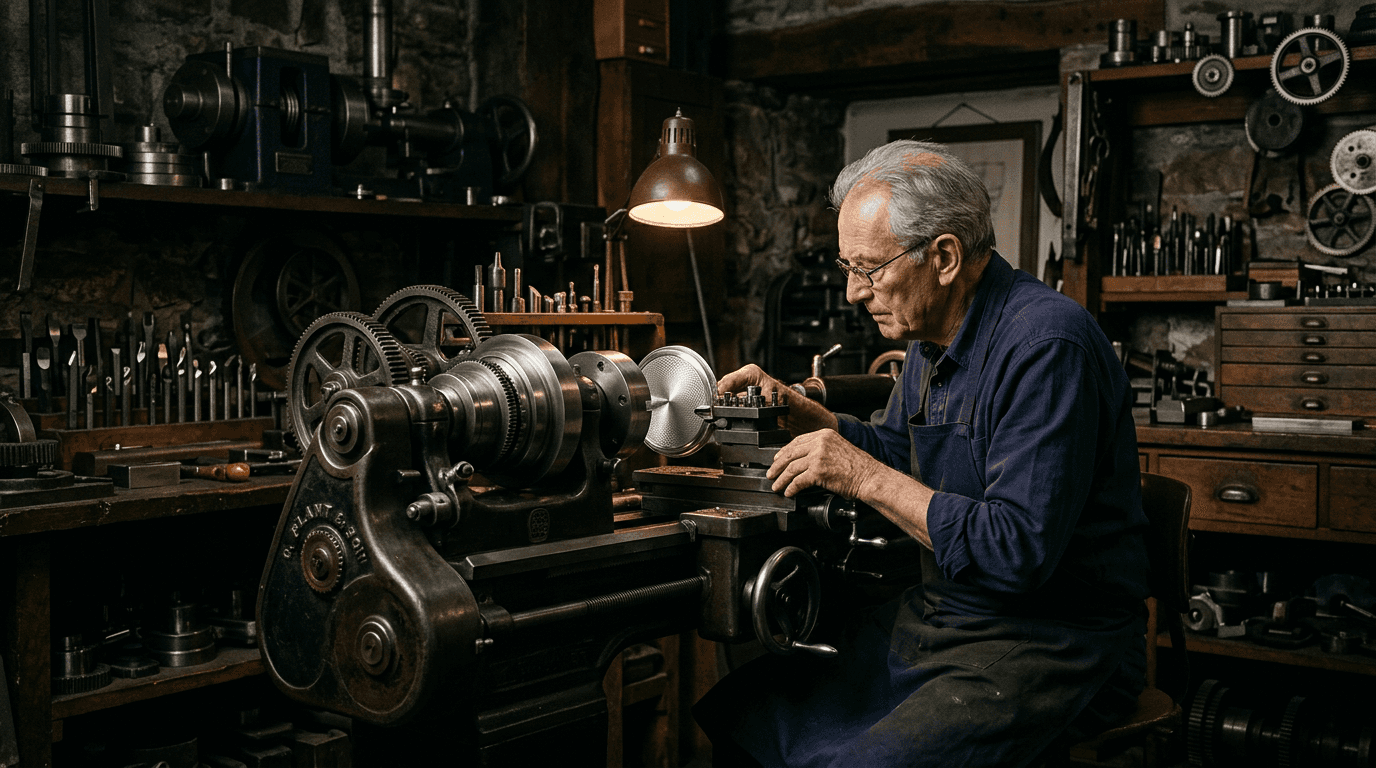
To the uninitiated, guilloché is simply a pattern on a dial—a barleycorn or a sunburst. But to a serious collector, it is a feat of mechanical choreography. Unlike modern stamping, where a hydraulic press forces a pattern into metal, true engine-turning involves a steady hand and a machine built before the dawn of the electric lightbulb.
"The machine does not have a brain," Jochen often reminds those who visit his atelier. "The tension of the spring, the sharpness of the diamond-tipped tool, and the exact pressure of my thumb—that is where the pattern lives."
If he pushes too hard, the tool skips, ruining a dial that may have already seen ten hours of labor. If he breathes too heavily, the uniformity of the light reflection—the very thing that makes a Breguet or a Vacheron Constantin dial "pop"—is compromised. It is a high-stakes performance of physics and art.
The Knowledge Gap
Why does this matter to the modern collector? Because we are currently living through a "Great Thinning" of artisanal talent.
As the secondary market for vintage and independent timepieces continues to break records, a quiet crisis is brewing. We are accumulating assets that require specialized maintenance, yet the pool of people capable of performing that maintenance is shrinking. When a 1950s Patek Philippe with a hand-turned dial suffers moisture damage or a scratch, you cannot simply order a replacement part from a catalog. You need a person who understands the specific geometry of the original rose engine used to create it.
Jochen is one of perhaps a dozen people globally who can claim this level of mastery. He doesn't just use these machines; he breathes life into them, sourcing parts from scrap heaps and restoring lathes that were abandoned during the Quartz Crisis. His knowledge isn't indexed in a PDF; it is stored in the muscle memory of his forearms and the callouses on his fingertips.
The Burden of the Specialist
Being "the last person who knows how" is a romantic notion, but it carries a heavy burden. For the industry, it creates a bottleneck. For the collector, it creates a risk.
If you own a piece of horological history, your investment is tethered to the existence of specialists like Jochen. This is why at WAX Collect, we often emphasize that collecting isn't just about the acquisition; it’s about the stewardship. Understanding the provenance of your watch includes understanding who has the skill to touch it.
Through our digital platform, we encourage collectors to document not just the watch, but the service history and the specific artisans involved in its life. When you use our free collection management tools, you aren't just cataloging a serial number; you are building a blueprint for the object's survival. If a specialist like Jochen retires, knowing exactly what was done to your piece becomes the most valuable data point you own.
Why We Should Care
We live in an era of "perfect" luxury—objects so precisely made by robots that they lack a pulse. The work of an engine-turner introduces a "human error" that is actually a form of perfection. Under a loupe, a hand-guilloché dial reveals tiny inconsistencies that give the metal a warmth that no laser can replicate.
For the budding collector, Jochen’s story is a reminder to look closer. Don't just buy the brand; buy the technique. For the serious collector, it is a call to action to support the independent artisans who keep these machines turning.
When the last person who knows how finally puts down their tools, the craft doesn't just stop—it becomes a myth. Our job, as collectors and protectors of culture, is to ensure that myth stays grounded in reality for as long as possible. Through proper insurance, meticulous documentation, and a deep respect for the "Vaulted Voices" of our industry, we aren't just buying watches. We are preserving the human ability to create something timeless.